
The 2026 FIFA World Cup final on July 19th is not merely a match; it is a funeral for the game as we knew it.
Every civilization has a moment that historians later recognize as the quiet beginning of a new age. It rarely arrives with the fanfare of revolution. More often, it wears the mask of progress,welcomed as improvement, applauded as common sense. The change is almost imperceptible, a slow accumulation of ordinary decisions, until one day we look up and realize we have crossed a threshold we never saw ourselves approaching.
Perhaps football has reached such a moment.
On July 19, when Argentina and Spain walk onto the pitch in New Jersey, billions will believe they are watching the conclusion of another tournament. They will celebrate the goals and debate the tactics. Few will notice that they are witnessing the quiet end of something far older than any trophy. For nearly a century, the World Cup was the last refuge of the romantic,a global mythology built on the absurd, beautiful idea that a child from a dusty street in Rosario, Lagos, or Manchester could, through pure, organic genius, bend the arc of history.
That era is over.
The 2026 World Cup has been a masterclass in the forced evolution of the sport. We have watched the game’s heartbeat become negotiable. The introduction of mandatory, universal hydration breaks regardless of climate has been defended as a medical necessity, but in practice, they have become a tactical reset button and a convenient commercial window for broadcasters. When we watch a game interrupted by corporate mandates, we are no longer watching a sport,we are watching a product optimized for advertisement, governed by the clock rather than the pulse of the crowd. This Americanization is compounded by the final’s planned 30 minute halftime spectacle, which bypasses traditional IFAB regulations to prioritize broadcast revenue over the physical integrity of the players.
The map of footballing power has not shifted; it has calcified. Since 1930, the trophy has never left the borders of Europe or South America, and 2026 has provided brutal proof that this is no longer a matter of talent. It is a matter of machinery. The world watched for a breakthrough from other regions, yet we are witnessing the total absorption of global talent into the highly professionalized, data gorged infrastructure of the traditional powers. We are witnessing the victory of institutional hegemony over the romantic dream of the underdog. The world’s richest reservoirs of talent, from Dakar to Recife, increasingly feed the world’s most sophisticated academies. Raw genius still exists, but it is quickly absorbed into institutions designed to remove randomness before it ever reaches the grand stage.
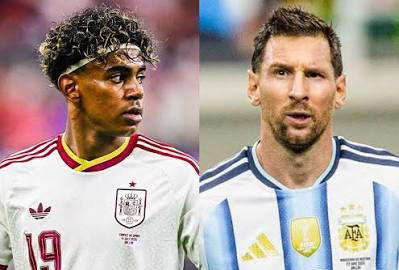
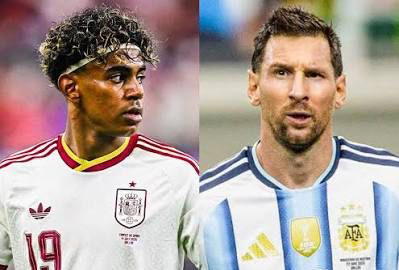
At the center of this transformation is the Sorcerer and the Apprentice, Lionel Messi and Lamine Yamal. Their narrative is the perfect, tragic metaphor for our moment. An iconic 2007 photo of a 20 year old Messi gently bathing an infant Yamal in a blue plastic tub during a charity photoshoot has been weaponized by media engines into a mythic passing of the torch. Nearly two decades later, that baby is the vanguard of a Spanish revolution against his former caretaker. Beneath the sentimentality, however, lies a colder truth: we are watching a machine replace its parts. Messi belongs to a generation whose genius emerged from organized chaos; Yamal belongs to an era where exceptional talent is identified earlier, developed faster, and refined with astonishing precision.
The apprentice has not replaced the sorcerer. The laboratory has quietly replaced the workshop.
The noise of this tournament,the political banners over the Falkland Islands, the disciplinary scandals regarding political messaging, and the ten million voices screaming for administrative accountability is not a distraction from the tournament. It is the tournament. It is the sound of a century old cultural identity cracking under the weight of hyper commercialized pressure. Even the logistics of the tournament, from the visa restrictions that hindered players and officials from nations like Iran to the labor disputes at major venues, have served as stark reminders that the global stage is increasingly governed by the complex geopolitical realities of the host nations. The tournament has forced a reckoning: as the sport continues to be optimized for global broadcast and corporate revenue, the tension between its identity as a cultural phenomenon and its reality as a global product has become the defining debate of the next generation.
None of this makes football worse. In fact, by almost every measurable standard, the game has never been more perfect. Players run farther, pass more accurately, and recover faster. We have not diminished football,we have perfected it. That may be precisely what we should fear. We never fell in love with football for its perfection, we fell in love with its refusal to behave. We loved the impossible equalizer that no tactical model predicted. We loved the unknown teenager who walked into a tournament and left as a national hero. Football constantly reminded us that humanity could still surprise itself. Its greatest gift was never excellence,it was surprise.
By the time the final whistle blows in New Jersey, we will have a champion, but we will have lost the game as we knew it. From here on out, the sport belongs to the architects of the infrastructure, the lobbyists of the boardrooms, and the managers of the monolith. Treasure the final whistle. It is the sound of an era passing away.
The post 2026 World Cup final – Messi vs Yamal: Sorcerer and the apprentice, by Stephanie Shaakaa appeared first on Vanguard News.
