

By Clifford Ndujihe, Politics Editor
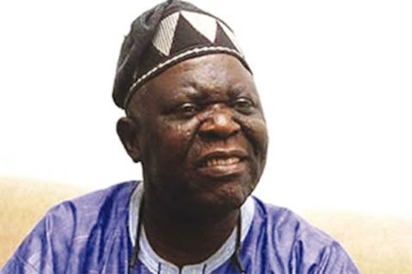
In “The Gun Hegemony,” Chief Ayo Opadokun, former secretary of the National Democratic Coalition, NADECO, and National publicity secretary of the Yoruba socio-political group, Afenifere, offers a rich, multi-sourced and third-party narrative on the Nigerian military.
Read Also: IPOB declares Monday, Feb 2 sit-at-home as ‘Biafra-Wide Lockdown’
More than a historical chronicle, the 427-page book published in 2025 by Bonaidea, Nigeria Limited, Lagos, interrogates the military’s intervention in Nigeria’s political evolution, rendered with scholarly depth and fearless candour. Anchored on the central thesis that military incursions have inflicted more harm than good on Nigeria, Opadokun argues that the officers who planned and executed the first coup, and subsequent ones, ultimately delivered mediocrity instead of progress, and disservice instead of salvation.
In abandoning their primary professional duty for political power, the uniformed men, he contends, failed woefully on both fronts— neither effective governors nor efficient soldiers. In Opadokun’s evocative metaphor, the military “chased two rats and lost both.” Having overthrown civilian governments, the officer corps found itself trapped in a paradox: incapable of mastering the art of governance and simultaneously diminished in professional soldiering. The result, he argues, was a legacy of aborted visions, fractured institutions and stunted national development.
One of the book’s major strengths lies in its depth of research and historical sweep. Opadokun traces the roots of the Nigerian Army to the colonial era and the emergence of the “Glover’s Hausas,” which he identifies as the genesis of the northernisation of the military. This imbalance, he argues, has remained an enduring malady, explaining the dominance of military formations in the North and the disproportionate influence the region continues to wield within the armed forces.
Beyond recounting Nigeria’s history of coups, The Gun Hegemony reproduces several maiden coup speeches verbatim, enriching its documentary value. Symbolically, Opadokun chose January 15, 2026, the 60th anniversary of Nigeria’s first military coup, to launch the book in Lagos. He painstakingly dissects the roles of key actors and counter-actors in that epochal event, including Chukwuma Nzeogwu, Johnson Aguiyi-Ironsi, Adekunle Fajuyi, Ahmadu Bello, Tafawa Balewa and Nnamdi Azikiwe, interrogating their actions and motivations in the chain of events that culminated in the putsch.
Perhaps the most striking contribution of the book is Opadokun’s deployment of rare and previously elusive materials from the EBranch of the Nigeria Police Force—the shadowy intelligence arm of the police. These documents, brought to light in the book, offer an official and largely unbiased account of the events of January 15, 1966, dovetailing into the counter-coup of July 1966. The book provides detailed lists of officers who survived the pogrom and how they escaped, as well as those who paid the ultimate price. Opadokun also ventures into the sensitive terrain of Col Emeka Odumegwu-Ojukwu’s role in the coup.
Drawing on what he describes as irrefutable materials, he argues that Ojukwu played more than a passive role, had prior knowledge of the coup and gave it tacit approval. He interrogates Ojukwu’s subsequent withdrawal when the coup faltered and his eventual decision to prosecute the Civil War against the counsel of some Igbo leaders.
Testimonies from Ojukwu’s kinsmen as Chief C. C. Onoh, as presented in the book, depict Ojukwu as an ambitious separatist driven by deep trust deficits that shaped his fateful choices. In an ambitious global sweep, Opadokun situates Nigeria’s coup experience within a wider historical context, tracing coups across civilizations — from biblical times to Europe, the Americas, Asia and Africa. Though he draws on acknowledged third-party sources, the breadth of this chronological mapping remains one of the book’s most remarkable feats.
Structured into 15 chapters and complemented by 152 pages of appendices and indexes, The Gun Hegemony stands out as a valuable resource for scholars and students of Nigerian history. Beyond content, the book impresses in form: high-quality printing, multimedia design, gloss-laminated and foiled-font cover, and durable bond paper—features that guarantee longevity and prominence in libraries. While many books have been written on the Nigerian military, Opadokun’s work distinguishes itself by crystallising the thesis, synthesis and antithesis of the military’s historical trajectory into a single, coherent and intellectually stimulating volume.
Unsurprisingly, the book does not shy away from controversy. Opadokun’s alignment with the argument that the January 15 coup was essentially an Igbo coup is bound to provoke fierce reactions, particularly from Igbo and South-East defenders. He reinforces this position by highlighting that no frontline Igbo politician or military officer of the First Republic was killed during the coup. He also draws attention to Dr. Nnamdi Azikiwe’s health holiday and boat cruise shortly before the coup, and General Aguiyi Ironsi’s failure to prosecute the largely Igbo coupists — actions that, he argues, fuelled Northern resentment and precipitated the July 1966 counter-coup.
Ultimately, The Gun Hegemony emerges as a compelling and indispensable resource for soldiers, scholars, students, historians, politicians, journalists, diplomats and all who seek to understand the evolution of Nigeria’s armed forces from colonial origins to contemporary times.
The post Coup, Power and Controversy: How ‘The Gun Hegemony’ rewrote Nigeria’s military history appeared first on Vanguard News.
