
*Tinubu may win without unity of opposition — Ben Obi; Timing of negotiations is a major obstacle — Adebayo; Adds opposition woke up late; Olawepo-Hashim frowns at lumping all opposition together
As opposition leaders intensify consultations ahead of the 2027 presidential election, rival ambitions, ideological differences and disagreements over candidate selection continue to complicate efforts to build a common front against President Bola Tinubu. LUMINOUS JANNAMIKE examines the obstacles confronting the opposition and the prospects for a united challenge.
Nigeria’s opposition leaders are united in their desire to challenge President Bola Tinubu in the 2027 presidential election, but translating that common purpose into a workable political alliance remains a more complicated task, with competing presidential ambitions, ideological differences and uncertainty over candidate selection threatening to undermine ongoing negotiations.
On Wednesday, President Tinubu inaugurated a coalition Presidential Campaign Council, PCC, including members from the Accord Party; All Progressives, Grand Alliance, APGA; and Peoples Democratic Party, PDP. The three opposition parties were represented in the ruling All Progressives Congress, APC, campaign team via Governor Ademola Adeleke of Osun State (Accord Party); Governor Chukwuma Soludo of Anambra (APGA); and Federal Capital Territory, FCT, Minister, Chief Nyesom Wike(PDP).
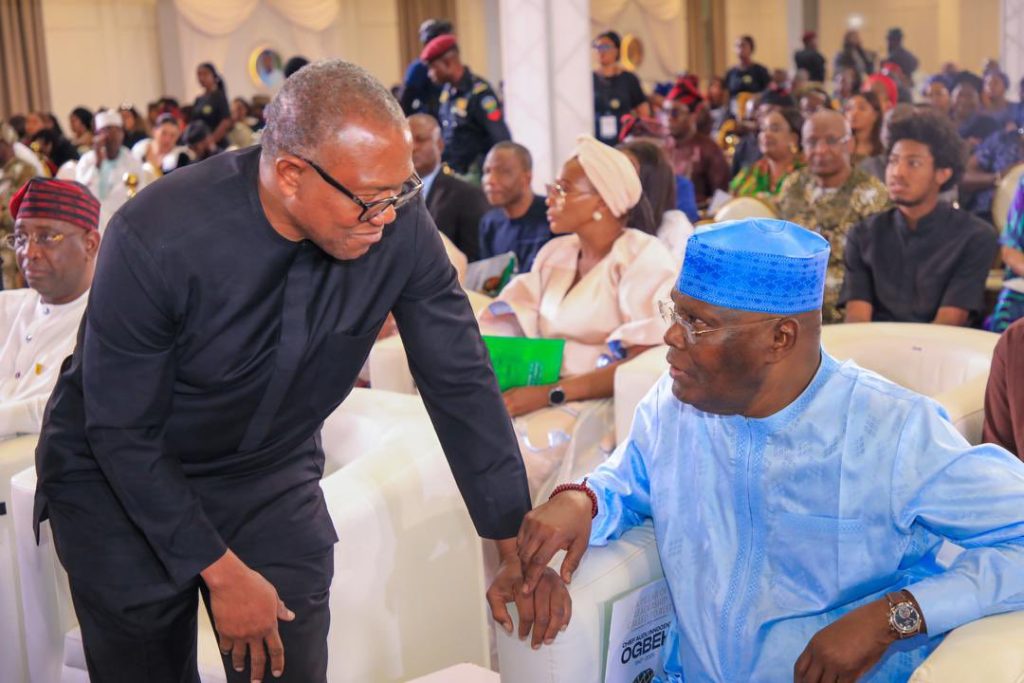
The APC, apparently, appears to have done first what the opposition is expected to do. Promoters of the coalition of leading opposition parties presidential candidates such as Alhaji Atiku Abubakar of the African Democratic Congress, ADC; Mr Peter Obi of the Nigeria Democratic Congress, NDC; Engr Seyi Makinde of the Allied Peoples Movement, APM; Mr Donald Duke of the Peoples Redemption Party, PRP; and Prince Adewale Adebayo of the Social Democratic Party, SDP.
While consultations among opposition parties have revived hopes of a common front, the central questions remain unanswered: who will lead the proposed coalition, how will the candidate emerge, and what guarantees will persuade other aspirants to accept the outcome?
The challenge is not merely to bring political leaders into the same room, but to secure an agreement that can withstand the pressures of presidential ambition, party interests and the struggle for control of a joint campaign.
From declarations to commitments
The Director of Media and Publicity of the ADC Presidential Campaign Council, Kola Ologbondiyan, told Saturday Vanguard that the opposition still has an opportunity to reach an arrangement before the election.
“I strongly believe that the opposition can mount a credible challenge to President Tinubu before the January 2027 election. And my belief is based on the decision reached at the meeting held in Ibadan among all the opposition political parties to look at that proposed grand alliance. The decision reached by the majority of the opposition parties was that, at the nick of time, they were going to pull together,” he said.
Ologbondiyan expressed confidence that the parties could still realign, despite the disagreements and political movements that have complicated efforts to build a common platform.
His optimism comes amid renewed consultations involving six opposition parties and presidential candidates, including Atiku Abubakar, Obi, Seyi Makinde, Donald Duke and Adewole Adebayo, over a framework for cooperation ahead of the 2027 polls. The consultations followed calls for sustained dialogue and coordinated action among opposition parties.
Yet, agreement to continue talking is different from an agreement on who should emerge as the coalition’s presidential candidate.
Tinubu may win without unity of opposition —Ben Obi
Senator Ben Obi, who told Saturday Vanguard that he had taken it upon himself to facilitate discussions among leading opposition figures, believes the consequences of failure could be significant.
“I believe very strongly that if the opposition does not come together, the incumbent might coast to victory. So, I gave myself an assignment,” Senator Obi said.
“Seyi Makinde is like my younger brother, just as Peter Obi is. Atiku is my boss and my friend, and we are like one family. So, I approached the three of them and took time to work things out with them.
“I said to myself that if the opposition did not come together, we would be wasting our time.”
Obi said he initiated discussions among Makinde, Peter Obi and Atiku, asking each of them to nominate two trusted associates to participate in a six-person committee. He subsequently approached former Ekiti State Governor Kayode Fayemi to coordinate the meetings.
“I told Kayode Fayemi, ‘Don’t allow the meeting to die,’” Obi said.
“They will not agree to step down for anybody. But, from the way I see things, we may reach a stalemate (at the polls in January, 2027). If that happens, this committee could become the answer.”
Whether the committee can help resolve that dilemma will depend on its mandate, the willingness of the principals to accept its recommendations and the extent to which any eventual understanding becomes binding.
Ambition meets ideology
For Comrade Mark Adebayo, Chief Communications Adviser to the Adebayo-Bugaje Presidential Campaign, who spoke to Saturday Vanguard, the timing of the negotiations is itself a major obstacle.
“I think the biggest obstacle to such a possibility (of a united front) is the time factor,” Adebayo said. “The conversations around different political Parties coming together to support a single presidential ticket came too late in the day, in my opinion. That’s a conversation that should have begun at least three years ago by building critical political infrastructures to achieve that. You can’t start such a crucial process on the eve of a general election.”
Opposition woke up late
Adebayo argued that a coalition requires more than last-minute consultations, pointing to the need for political structures capable of sustaining joint mobilisation and translating agreements among leaders into coordinated action across the country.
He also identified ideological differences among the parties and their presidential candidates as a fundamental obstacle.
“Secondly, the differences in political and governance ideologies of the various Parties and candidates would also constitute fundamental obstacles to such possibility,” he said.
“I think the opposition woke up to that realization too late. Meanwhile, while I agree it is extremely challenging, it is not impossible for one presidential candidate to defeat the incumbent.”
Adebayo said a successful challenge would require extensive mobilisation around a common political programme, adding that Prince Adewole Adebayo was working towards that objective.
His position raises a question that extends beyond the timing of the negotiations: how much ideological agreement is necessary for opposition parties to work together?
Gbenga Olawepo-Hashim, the Accord Party presidential candidate, has drawn a distinction between his political outlook and those of Atiku and Obi, arguing that opposition politicians should not automatically be treated as members of the same ideological bloc simply because they oppose the ruling party.
Olawepo-Hashim frowns at lumping all opposition together
Speaking on Seun Okinbaloye’s Mic On Podcast, Olawepo-Hashim said: “There are opposition candidates who share the left-centre ideology, more welfarists, more sympathetic, more compassionate to the common people. Sowore, Adebayo and I belong to that. So we shouldn’t be lumped together.”
Olawepo-Hashim described himself, Omoyele Sowore of the African Action Congress and Adewole Adebayo of the Social Democratic Party as sharing a left-centre, welfarist orientation. He placed Atiku and Obi in what he described as the extreme conservative political wing, particularly in relation to economic policy and petrol subsidy.
When asked whether the three politicians had formed an alliance, he replied on the podcast:
“We already did. We signed it in Port Harcourt, and it was in the public space.”
The agreement, involving the Accord, AAC and SDP presidential candidates, represents a distinct initiative from the broader consultations among opposition parties. Its existence does not, in itself, establish that the wider opposition has agreed on a joint presidential ticket.
The distinction also illustrates the competing approaches to cooperation. While some leaders are exploring a broad arrangement that could bring different political tendencies together, Olawepo-Hashim has emphasised the importance of shared ideological ground.
The unresolved question is whether parties with different economic philosophies can agree on a limited common programme while retaining their individual identities, or whether such differences will become another source of disagreement when the negotiations reach substantive policy questions.
Who leads, and on what terms?
Beyond ideology, the opposition must settle the practical details that determine whether a coalition can function as a single political force.
The first is candidate selection. A credible arrangement would require an agreed process for choosing a presidential candidate, whether through consensus, a negotiated formula or another mechanism acceptable to the participating parties.
The second is the treatment of unsuccessful candidates. Senator Obi’s account suggests that persuading leading contenders to step aside may be difficult, making it necessary to establish in advance how disagreements will be resolved and what commitments participants will make to support the eventual candidate.
Power-sharing presents another challenge.
Decisions on the running mate, joint campaign leadership, funding, messaging and grassroots mobilisation could become contentious unless the parties agree on clear responsibilities and decision-making procedures.
There is also the question of whether the parties can sustain cooperation beyond the negotiations themselves. A coalition that announces a common purpose but retains separate campaign commands, competing messages and conflicting political priorities could struggle to demonstrate that its agreement amounts to more than an understanding among leaders.
Ologbondiyan’s expectation that opposition parties could pull together at a decisive moment and Senator Obi’s account of efforts to prevent the talks from collapsing offer two perspectives on the same challenge. Adebayo, meanwhile, warns that the necessary political groundwork should have begun much earlier.
Taken together, their accounts show that the opposition’s task is not simply to agree that Tinubu should be challenged, but to determine how that challenge will be organised and who will exercise authority within it.
The post 2027: Why Tinubu’s challengers are struggling to unite appeared first on Vanguard News.
