
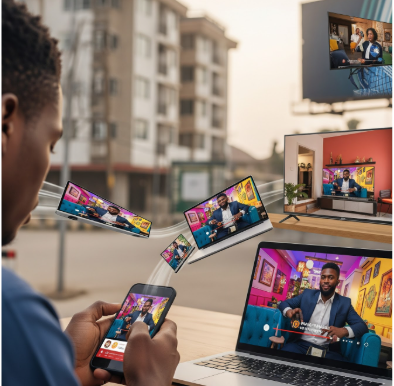
I remember the very first client who asked me to create a video advert that could “work everywhere.” We were in a tiny office in Lagos, sweating through NEPA outages and expectations. The brief was simple: reach students in Nsukka, professionals in Abuja, and market women in Ibadan with one video.
I laughed initially because this was 7 years ago. How do you make one video communicate with people on phones, TV, and even roadside billboards? But once I went into bus parks, university hostels, and open markets, I saw the truth: Nigerians consume content differently, but they all respond to good storytelling. The challenge was how to adapt the same message across screens.
I learned more from that campaign than any digital course. I cut high-energy verticals for TikTok and Instagram, slowed things down for YouTube, made the TV ads bold and proudly local. I even turned WhatsApp into a space for emotional, 60-second punchlines.
In Nigeria’s mobile-first world, video isn’t just content, it’s connection. But only when it’s made for the screen and the soul.
With over 150 million mobile subscriptions and rising internet use, Nigerians live online. Data costs shape viewing habits, so short, optimized videos thrive especially on TikTok, Instagram, YouTube, and Facebook.
Smartphones dominate, especially for Gen Z and millennials. Yet TV and outdoor still matter, particularly in rural areas. For brands, the rule is simple: be on every screen or risk being invisible.
Why Multi-Platform Video Strategy Matters
Cross-platform video strategy means creating content that is effective on all platforms it is released on—respecting the variations in screen size, behavior, format, and presentation of the message. What that looks like in Nigeria:
1. Mobile-First Short Form for Social Media
With Nigeria’s young population that has a strong connection to TikTok, Instagram Reels, and WhatsApp Statuses, brands find themselves interested in snackable, vertical content that is relatable, trend-relevant, and emotionally compelling. For instance, telecommunication companies like MTN and Airtel are often inclined to use localized skits that are less than a minute long, presenting offers or services using humor and music.
Best Practices:
-
Employ the local languages or Pidgin English for purposes of emotional connectivity.
-
Prioritize subtitles because viewers watch in mute
-
Ride trends, dances, and memes.
-
Keep videos data-light and have quick load times.
2. YouTube and VOD for Long-Form Storytelling
YouTube has become a storytelling zone in Nigeria, where it is used for music videos, vlogs, documentaries, and brand web series. Nigerian audiences are open to narrative content, which makes YouTube an excellent platform for longer-form videos that inform, motivate, or entertain.
Case Study:
Airtel’s “Meet The In-Laws” campaign utilized YouTube to bring to life typical Nigerian family life but wove in product use subtly—tuning into hearts with authenticity.
Best Practices:
-
Focus on emotional storytelling with a cultural sensibility.
-
Utilize playlists and consistent uploads to build audience retention.
-
Partner with local creators or influencers.
3. TV and Outdoor: Big Screen, Bold Impact
TV and outdoor digital billboards are still the stronghold in Nigeria for high-scale campaigns targeting older people or groups with poor smartphone penetration. Any video here should be high-definition, straightforward, and effective within seconds.
Best Practices:
-
Use high production value and graphic imagery.
-
Simplify messages to make them memorable and slogan-based.
-
Back digital campaigns to create cross-platform power.
4. WhatsApp: The Viral Dark Horse
WhatsApp is likely Nigeria’s most powerful low-key video platform. Videos get shared here—sometimes without people even knowing where the first exposure was. Grassroots movements, religious content, and even political videos make their way onto here.
Best Practices:
-
Get people to react to videos—hope, shock, or laughter.
-
Keep them short (under 60 seconds) and low-data.
-
Add logos or watermarks so that brand credit is given.
Adapting Across Platforms: One Story, Many Forms
To be successful on screens in Nigeria, the message must be uniform while the form changes. To illustrate, a youth empowerment campaign can include:
-
A 15-second meme-form teaser on Instagram
-
A 3-minute mini-documentary on YouTube
-
A testimonial reel shared on WhatsApp
-
A powerful, slogan-based TVC for broadcast prime time
-
A catchy, musical clip on TikTok or Boomplay
All the videos would convey the same message, but their design, length, and language would differ depending on where and how it is consumed.
In Nigeria’s fast-paced, mobile-first economy, the all-same video approach is no longer viable. Success hinges on discovering audience behavior, respecting platform culture, and creatively optimizing for each screen. Brands and content creators who grasp these principles won’t just reach millions—they’ll connect with, inspire, and convert them.
In conclusion: Think Local, Act Platform-Smart
As Nigeria steps into the future with its digital expansion, the role of video in multi-screen campaigns isn’t getting bigger—it’s changing how brands build trust, spark conversation and drive outcomes. The screens change, but the power of video remains the same.
Discuss with us today to get your video project started; reach out at www.pulsemarketing.africa or @pulsemarketingng on Instagram.
By Adekunle Bryan Oyetunde
